• You're one step from joining Tiny Home Forum – Space Saving Hacks, Off-Grid Living & DIY Builds.
    Create a free account to post, follow threads, and never miss an update.  Sign up free →

Choosing a mini split for a tiny home

yanneb

New member
Joined
Jan 30, 2026
Messages
4
I am currently planning my tiny home build and need to figure out the right HVAC setup. A mini split seems perfect for both heating and cooling but I am struggling with the sizing. My space will be well insulated and small but the online calculators give me very different results. I am looking at budget friendly Costway units and the price gap between the 9000 and 12000 BTU models is quite small. I worry that a 9k unit might fail me during a freezing winter night while a 12k unit might turn on and off too often. And I really want to hear from people in cold climates about which size actually works best in the real world.
 
I am currently planning my tiny home build and need to figure out the right HVAC setup. A mini split seems perfect for both heating and cooling but I am struggling with the sizing. My space will be well insulated and small but the online calculators give me very different results. I am looking at budget friendly Costway units and the price gap between the 9000 and 12000 BTU models is quite small. I worry that a 9k unit might fail me during a freezing winter night while a 12k unit might turn on and off too often. And I really want to hear from people in cold climates about which size actually works best in the real world.

Have you checked the low ambient heating rating to see if the unit still works at sub zero temperatures?
 
I am currently planning my tiny home build and need to figure out the right HVAC setup. A mini split seems perfect for both heating and cooling but I am struggling with the sizing. My space will be well insulated and small but the online calculators give me very different results. I am looking at budget friendly Costway units and the price gap between the 9000 and 12000 BTU models is quite small. I worry that a 9k unit might fail me during a freezing winter night while a 12k unit might turn on and off too often. And I really want to hear from people in cold climates about which size actually works best in the real world.

It helps to install the outdoor compressor on a stand so it stays clear of heavy Colorado snow banks.
 
Just a thought for a backup. I used to have family in the Boston area and saw one of these set up's up there.

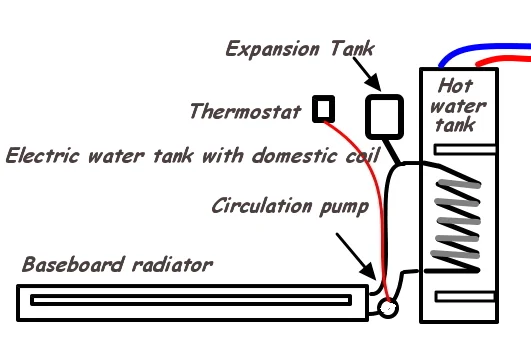
You can go ahead with the mini split but add this which wouldn't take up much space. You may have a hot water tank to heat water but if you look around some of these tanks can be purchased with a domestic water heating coil built in. Not that you would be using it for it's purpose but to supply a baseboard hydronic heating set up.

This would require a very small pump and only be a one zone system for the TH. It would be charged with water and a non toxic antifreeze mixture. (like RV winterizing or swimming pool antifreeze) The pump would be cycled with a thermostat that could be turned on when needed. The hot water tank would
always have hot water so that the domestic coil could supply hot water to the baseboard radiator system. It wouldn't take much space.

But it's just a thought.
 
I wanted to follow up with a simple sketch of what I described above. Some manufacturers produce hot water heating tanks with a domestic heating coil built in. The coil can be used for a variety of applications. In this case secondary heating.

The sketch shows a baseboard hydronic heating system. But even Pex Tubing can be run in the flooring to create a heated floor along with the baseboard heating.

What one has to remember (and the news media here is reminding everyone in this brutal winter weather) is that if you have a Heat Pump and the temperature goes below 35 to 30 degrees F you need to switch to emergency/auxiliary heat. This is electric heating strips to provide more efficient and less costly heat. The Heat Pump is several times more efficient above 35 degrees F but the opposite below 35.

A well insulated Hot Water Tank with domestic coil could serve as electric heating if the Mini Split doesn't have auxiliary electric heating strips.

TH Hot Water Tank Heat.webp
 
I wanted to follow up with a simple sketch of what I described above. Some manufacturers produce hot water heating tanks with a domestic heating coil built in. The coil can be used for a variety of applications. In this case secondary heating.

The sketch shows a baseboard hydronic heating system. But even Pex Tubing can be run in the flooring to create a heated floor along with the baseboard heating.

What one has to remember (and the news media here is reminding everyone in this brutal winter weather) is that if you have a Heat Pump and the temperature goes below 35 to 30 degrees F you need to switch to emergency/auxiliary heat. This is electric heating strips to provide more efficient and less costly heat. The Heat Pump is several times more efficient above 35 degrees F but the opposite below 35.

A well insulated Hot Water Tank with domestic coil could serve as electric heating if the Mini Split doesn't have auxiliary electric heating strips.

View attachment 84
Thanks @eDJ_! This is what I need to know.
 
Just a thought for a backup. I used to have family in the Boston area and saw one of these set up's up there.

You can go ahead with the mini split but add this which wouldn't take up much space. You may have a hot water tank to heat water but if you look around some of these tanks can be purchased with a domestic water heating coil built in. Not that you would be using it for it's purpose but to supply a baseboard hydronic heating set up.

This would require a very small pump and only be a one zone system for the TH. It would be charged with water and a non toxic antifreeze mixture. (like RV winterizing or swimming pool antifreeze) The pump would be cycled with a thermostat that could be turned on when needed. The hot water tank would
always have hot water so that the domestic coil could supply hot water to the baseboard radiator system. It wouldn't take much space.

But it's just a thought.
Yes, I think it wouldn't take up much space. Just set it up proprely.
 
I wanted to follow up with a simple sketch of what I described above. Some manufacturers produce hot water heating tanks with a domestic heating coil built in. The coil can be used for a variety of applications. In this case secondary heating.

The sketch shows a baseboard hydronic heating system. But even Pex Tubing can be run in the flooring to create a heated floor along with the baseboard heating.

What one has to remember (and the news media here is reminding everyone in this brutal winter weather) is that if you have a Heat Pump and the temperature goes below 35 to 30 degrees F you need to switch to emergency/auxiliary heat. This is electric heating strips to provide more efficient and less costly heat. The Heat Pump is several times more efficient above 35 degrees F but the opposite below 35.

A well insulated Hot Water Tank with domestic coil could serve as electric heating if the Mini Split doesn't have auxiliary electric heating strips.

View attachment 84
Nice of you to make the illustration. Thanks for sharing this.
 
As it was explained to me Alan, the power grid there "is" rather dependable and likewise the water supply. So they always have water, both hot and cold, heat, and electric.

I'm sure this could be adapted for off grid installations. It may require a generator such as a Generac propane gen set, photovoltaic panels for power in order to be secure. (propane fueled generators run very clean and last a long time, but special motor oil for propane fueled engines should be used. (It is easy to find and affordable)

images


I've looked into sun tracking "heliostats" which are similar to a satellite dish. These focus the suns lights on a stem mounted coil that water/coolant is piped thru. (focusing similar to a Satellite TV Dish) This requires a small pump and power with insulated runs to the domestic coil hot water tank. There is a second reduction geared motor (known as a linear actuator) that is controlled by an electronic "solar tracking device" such that the heliostat tilts & turns to follow the sun thru it's arc all day making it quite efficient. When the sun rises the next morning, it returns to the east position to repeat it's operation. Thus the heliostat is fully automated and the user only needs to keep the mirror panels cleaned from time to time.


images


In the above photo the stationary solar hot water panel would not be used if the heliostat were employed in it's place.

There are solar hot water heaters like this one but I don't know if any come with domestic water heating coils in them. Heaters of this design have been around since the earlier 1900's. (but have been largely forgotten) But they are making them again now.

A friend of mine built a house and placed one small solar hot water panel on the roof. He said that by noon he could burn himself with the hot water if he wasn't careful. His hot water tank had the domestic hot water coil feature that the roof mounted solar hot water panel pumped thru. At night the electric heating elements in the tank kept the water hot.

images
 
Last edited:
Back
Top