eDJ_
Well-known member
- Joined
- Apr 21, 2025
- Messages
- 193
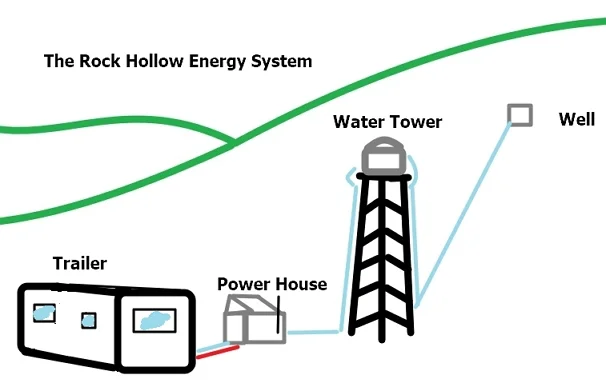
Some year ago I was at a Public Library reference room looking thru old copies of Mother Earth News Magazine. (now a bi monthly publication) I happened to find this story about an Alabama couple who owned some land and moved a house trailer out to a spot they liked on that land. The problem was it was almost a mile from the power grid. So the couple set forth to design a power system that would deliver their electrical needs as well as water. (even heated water)
Here is what they had to do. First they drove a well with a do it yourself machine. (rented, borrowed ?) Next they built a 30 ft tower of wood boards and mounted a plastic tank on top of it. (so gravity would provide flow) This also required water pressure reducers to have the effect of city water utility pressure such as the trailer was set up for.
Scavenging some found them a Golf Course that periodically replaced the batteries in the rental carts long before they were going bad and sold them. (rental companies do this to assure reliability of their equipment) So they purchased several to tie together to have one large battery bank.
The next purchase was of a 500 gallon propane tank that the Propane Company had pulled from service due to it's age. The tank was first flooded with water to drive out any propane gas as they would cut a square section out of the top of it with a cutting torch later. This was to install a copper tube domestic hot water heating element for hot water to the trailer. There was a small input and output pipe welded in toward the bottom side of the tank.
Then a small car engine was purchased from a wrecking yard. It happened to be from a Ford Pinto car and would be mounted into a welded up metal frame placed beside the big propane tank so that the water pump of the engine would connect to the two pipes at the side of it thru flexible hoses.
The next modification was to the Pinto engine was where a Sears & Roebuck 240/110 VAC alternator was mounted to work along with the 12 VDC alternator the engine came with originally. Sears sold these at the time but others including Harbor Freight has carried them. (not sure if they still do or not) Sears unit sold for $400 in the 1980 era.
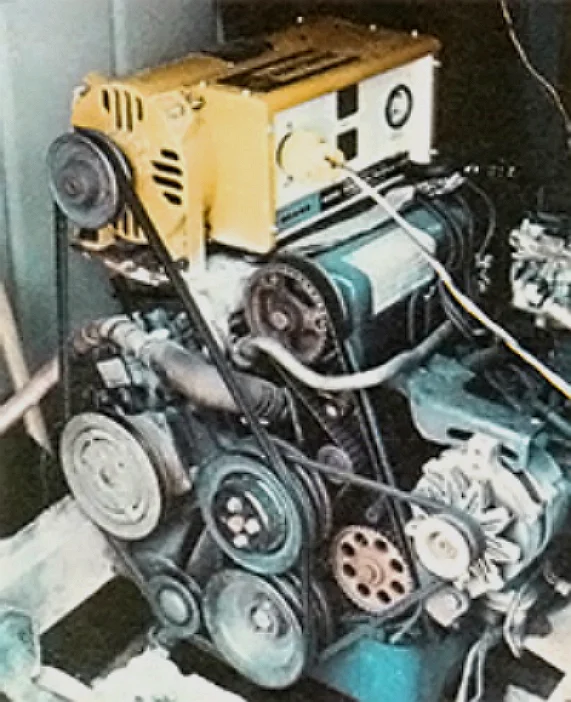
So the engine looked like this all set up with the special tan alternator at the top:
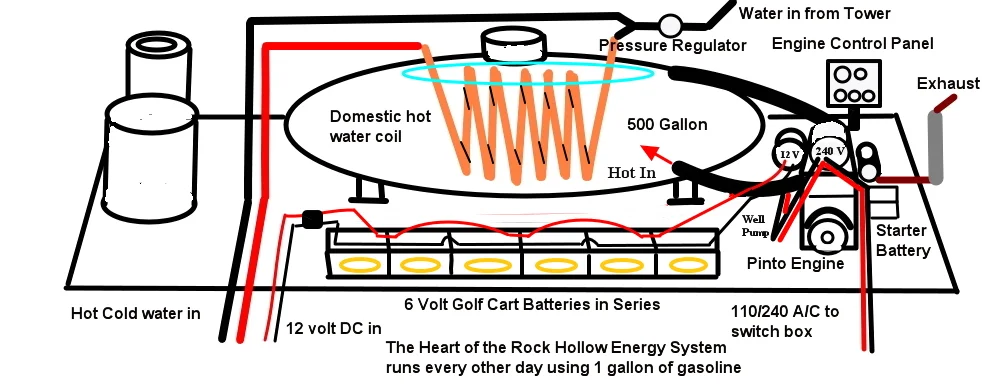
When it was all put together beside the trailer it looked like this sketch:
I don't have a sketch of the water tower but you can imagine it with the plastic 150 gallon water tank. The tank would weigh a little over 1200 lbs when full. But.....if you were set up near a hill side the tank could be placed on the ground if an intention was dug into the hillside so it could set level and the pipe ran down hill. (thus not requiring the tower....but they lived on flat land and had no choice)
Thus, in operation. The Pinto motor was started every other day and ran at around 3500 rpm for 20 minutes to produce the 240 VAC power for the well pump to fill the water tank. (or until it overflowed) Then the engine speed was reduced to about 1500 rpm for the next 40 minutes or until the batteries were fully charged by the engines 12 VDC alternator. They calculated about 15 gallons of gas used each month.
To the interior of the trailer they replaced all of the lighting with 12 volt fluorescent fixtures and purchased 12 volt appliances where possible. Their sound system was taken from a car with AM/FM Cassette and speakers to work on 12 volt. A car CB radio served for their connection to the outside world. The kitchen stove/oven and space heating in this all electric trailer were swapped for propane so that he could use gas bottles that a delivery truck would bring as needed.
This represents the best I can remember of the story. But I think it would benefit an off grid Tiny Home just as easily. But one would have to have considerable property and be away from codes.
What prompted his drive to create this solution was the cost of setting telephone/power poles for a one mile distance from the grid. No natural gas service was available either way out there. Their mail was delivered at the main road in a rural route mail box so each day they had a two mile drive to get the mail. (out and back) A bicycle or moped could be used on nice days I guess.
Here is what they had to do. First they drove a well with a do it yourself machine. (rented, borrowed ?) Next they built a 30 ft tower of wood boards and mounted a plastic tank on top of it. (so gravity would provide flow) This also required water pressure reducers to have the effect of city water utility pressure such as the trailer was set up for.
Scavenging some found them a Golf Course that periodically replaced the batteries in the rental carts long before they were going bad and sold them. (rental companies do this to assure reliability of their equipment) So they purchased several to tie together to have one large battery bank.
The next purchase was of a 500 gallon propane tank that the Propane Company had pulled from service due to it's age. The tank was first flooded with water to drive out any propane gas as they would cut a square section out of the top of it with a cutting torch later. This was to install a copper tube domestic hot water heating element for hot water to the trailer. There was a small input and output pipe welded in toward the bottom side of the tank.
Then a small car engine was purchased from a wrecking yard. It happened to be from a Ford Pinto car and would be mounted into a welded up metal frame placed beside the big propane tank so that the water pump of the engine would connect to the two pipes at the side of it thru flexible hoses.
The next modification was to the Pinto engine was where a Sears & Roebuck 240/110 VAC alternator was mounted to work along with the 12 VDC alternator the engine came with originally. Sears sold these at the time but others including Harbor Freight has carried them. (not sure if they still do or not) Sears unit sold for $400 in the 1980 era.
So the engine looked like this all set up with the special tan alternator at the top:
When it was all put together beside the trailer it looked like this sketch:
I don't have a sketch of the water tower but you can imagine it with the plastic 150 gallon water tank. The tank would weigh a little over 1200 lbs when full. But.....if you were set up near a hill side the tank could be placed on the ground if an intention was dug into the hillside so it could set level and the pipe ran down hill. (thus not requiring the tower....but they lived on flat land and had no choice)
Thus, in operation. The Pinto motor was started every other day and ran at around 3500 rpm for 20 minutes to produce the 240 VAC power for the well pump to fill the water tank. (or until it overflowed) Then the engine speed was reduced to about 1500 rpm for the next 40 minutes or until the batteries were fully charged by the engines 12 VDC alternator. They calculated about 15 gallons of gas used each month.
To the interior of the trailer they replaced all of the lighting with 12 volt fluorescent fixtures and purchased 12 volt appliances where possible. Their sound system was taken from a car with AM/FM Cassette and speakers to work on 12 volt. A car CB radio served for their connection to the outside world. The kitchen stove/oven and space heating in this all electric trailer were swapped for propane so that he could use gas bottles that a delivery truck would bring as needed.
This represents the best I can remember of the story. But I think it would benefit an off grid Tiny Home just as easily. But one would have to have considerable property and be away from codes.
What prompted his drive to create this solution was the cost of setting telephone/power poles for a one mile distance from the grid. No natural gas service was available either way out there. Their mail was delivered at the main road in a rural route mail box so each day they had a two mile drive to get the mail. (out and back) A bicycle or moped could be used on nice days I guess.