• You're one step from joining Tiny Home Forum – Space Saving Hacks, Off-Grid Living & DIY Builds.
    Create a free account to post, follow threads, and never miss an update.  Sign up free →

DIY PCV non electric water pump for your well or water supply

eDJ_

Well-known member
Joined
Apr 21, 2025
Messages
193
Some of the most ingenious things I've seen for off grid live are those of the Amish Farmers. Granted some of their stuff wouldn't pass code in the city but we're talking about off grid. What you will see in this post is a pump made mostly out of PCV pipe with only a few metal fittings. The pump has no moving parts except for a spring loaded check valve to regulate the flow of the water in one direction. It's simple enough most anyone could build one too.

The pump runs as long as you leave it running. But if you shut it off you'll have to take an tire pump to charge it with compressed air again. But that's no big problem. It only takes a couple of minutes and then you can have all the water your source can offer. An inexpensive project that can fill water tanks or cisterns to have utility water. If you are cooking or drinking the water it will be important to know if it is a safe potable supply.

So here is a Yutube video showing how it's done.

 
I've seen a few versions of those PVC airlift pumps before, but the Amish always seem to refine things in the most practical way. Oh well, definitely a neat off grid project if you've got a reliable water source
 
I saw one recently that used a couple of permanent magnets that I'm guessing were circular with a hole in the center. Probably set to repel each other when they came together. So the water pressure on one side would push them together and the magnets would push back to maintain the water flow without any electric power.
 
Awesome find! I find it cool to get new ideas, especially when it's about off-grid living! A pump with no moving parts besides a check valve is pure genius. It makes so much sense for a tiny home, especially if you're out in a remote area and don't want to rely on electricity or a complicated setup that could break down. That makes you realize how sometimes we've overcomplicated a lot of things!
 
If you have 15 minutes and want to watch this Youtube video showing how one is made and see it operating I think it will be worth your time. In this video they are pumping from a lake or river, but if you have a well that's been drilled or driven then I'd imagine this would work just as well. Or if filling a cistern using the pump. That way the cistern could use a solar battery powered small pump motor delivering a couple of gallons per minute.

 
PVC and a check valve is about as cheap as it gets. If you've already got a compressor or even a bike pump, it's basically free water movement. Biggest expense is time tinkering with it to dial in the flow.
 
I think the only real drawback is the need for the initial compressed air "charge," which is a minor inconvenience but a necessary part of the design. The safety note about potable water is also crucial.. the pump itself doesn't purify the water, so knowing your source is the most important step for health and safety.

It's a perfect example of the kind of practical, durable innovation that comes from a focus on self-sufficiency. Which is good.
 
@eDJ_ I like this is a nice post, the biggest thing to remember with ram pumps is they're not for every situation.
They need a steady, flowing water source and a sufficient drop in elevation to work. They also waste a lot of water to pump a small amount, but if you have a stream on your property, it's a trade off that's a hundred times better than no pump at all
 
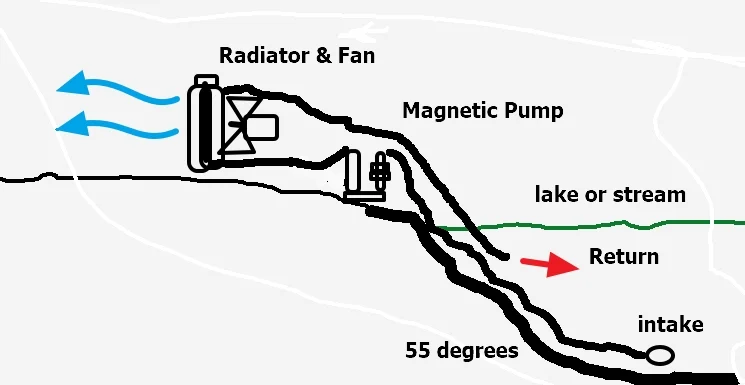
Thank you. Some time ago I designed an AC system using a old used radiator from a small car to pump cold water thru while a fan blew air thru the radiator to deliver cold air. It would have to be near a body of water and have electric power to run the small fan motor. Under the radiator would be a piece of roof guttering sealed on both with a small hose to drain away the condensation.

I'm guessing the water intake would have to be down 9 to 12 feet deep to have 55 degree water.

Solar panels and storage batteries may be enough to provide power to the fan.

The setup would look something like this. Again one would have to be near a body of water for this to work.


cold water ac.webp
 
Back
Top